
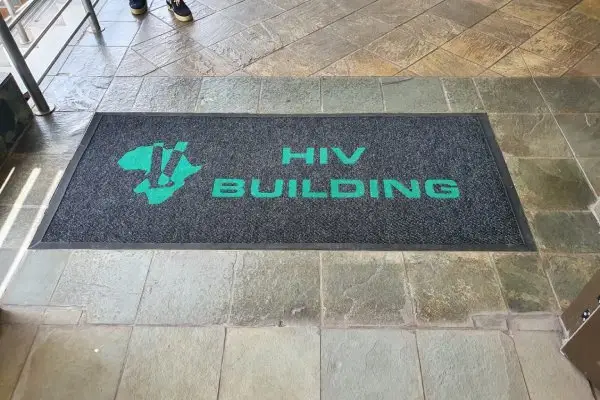
A branded entrance mat works hard. It receives footsteps, collects soil and carries your company name at the point where customers enter. Keeping it clean helps the logo stay visible and gives your reception, shop or office a well-maintained appearance.
How do you clean Berber Point logo mats? Start with regular vacuuming to remove loose dirt, blot liquid spills promptly and check the mat’s edges, inlay joins and backing. Use cleaning products and deeper-cleaning methods approved for the complete finished mat. After an approved wet clean, allow the surface and underside to dry before returning it to a clean, dry floor.
This guide covers routine care, spills, deeper cleaning and inspection for South African businesses. It focuses on custom carpet inlay mats: the carpet, logo pieces, adhesive, backing and edging all matter when deciding how to clean them.
1. Identify your logo mat before cleaning it
Two mats can look similar and have different care requirements. A printed design, a carpet inlay and an all-rubber mat are different constructions. Instructions for one should not automatically be applied to another.
Avidaze makes custom inlaid logo mats by cutting solid-colour carpet pieces and fitting them into the design. Berber Point is our standard carpet surface, with rubber backing and an edging finish agreed during quotation. See our custom logo mat materials and options.
Is Berber Point the same as general Berber carpet?
General Berber carpet guides often discuss looped carpets. Berber Point is a specific commercial carpet range; Belgotex describes Berber Point 920 as structured needlepunch polypropylene carpet. Check which product you have rather than relying on the word “Berber” alone. View Belgotex’s Berber Point 920 specifications.
The carpet manufacturer’s guidance is useful, but a loose-laid logo mat includes additional components. Confirm the care method for the assembled mat, especially before applying heat, soaking it or using powerful cleaning equipment.
If your mat has no care label or instructions, send its supplier photographs of the surface, underside and edging. Include any order details you have and explain the cleaning method you are considering.
2. Follow a consistent routine for loose dirt
Inspect before you begin
Look for raised corners, loose edging, lifting inlay pieces and visible backing damage. If a section is separating, avoid running cleaning equipment across it and ask for repair advice. Cleaning does not repair a damaged join.
Choose a time when the entrance can be maintained without people stepping over equipment. Larger mats may require assistance to move; do not drag them by a loose border or lift them by one small section.
Vacuum the whole surface
Use a vacuum and settings suitable for the mat’s construction. Check the cleaning head for sharp or damaged parts, then work methodically across the surface. Pay attention to the main walking line, corners and the areas around lettering.
A practical routine is to:
- Check that the mat lies flat and has no loose pieces.
- Vacuum the full surface using suitable equipment.
- Give visibly soiled areas additional passes as needed.
- Inspect for remaining marks and record anything requiring treatment.
- Check that the mat is correctly positioned before reopening the area.
Avoid forcing the vacuum over a lifting logo piece or damaged edge. Stop and have the problem assessed.
Check the floor underneath
When the mat can be moved safely, lift it carefully and inspect the floor beneath. Remove accumulated dirt and clean the floor using a method suitable for that flooring. Check the backing for debris and follow the mat supplier’s instructions for cleaning it.
Replace the mat only when the floor and underside are dry. Confirm that the corners sit flat and the door opens freely. If the mat continues moving, investigate the floor conditions, backing compatibility, dimensions and wear.
3. Deal with spills without aggressive scrubbing
Attend to a spill promptly and identify what caused it. Coffee, food, oil and paint may need different treatment. Repeatedly applying a general-purpose cleaner can make assessment more difficult.
For a liquid spill, blot excess liquid with a clean, absorbent white cloth. Avoid vigorous rubbing around the logo and joins. Carefully lift loose solid material without pushing it further into the surface.
Check before applying a stain remover
Use a product approved for the finished mat and follow its instructions. Test it in an inconspicuous area first, watching for colour transfer, texture changes or lifting at a join. A successful spot test does not override the supplier’s restrictions on chemicals or cleaning methods.
Use the specified dilution and application procedure. Follow the approved instructions for removing residue and drying. Stop if the surface changes, colour transfers or a piece starts to lift.
For an unidentified or persistent stain, send a photograph to the supplier or a suitable professional cleaner. Explain the substance involved, when it happened and any products already applied.
4. Confirm the method before deeper cleaning
Routine vacuuming and prompt spill treatment may not address every build-up of soil. A deeper clean can be appropriate, but its method should suit the complete mat.
| Method | What needs checking |
|---|---|
| Routine vacuuming | Equipment settings, cleaning head condition and any loose edges or inlay pieces. |
| Spot-cleaning | Stain type, approved product, dilution, colour compatibility and residue removal. |
| Hose rinsing | Whether the finished mat permits it, including pressure, temperature, detergent and handling. |
| Carpet extraction | Approval for the equipment, temperature, chemicals, moisture level and drying process. |
| Professional cleaning | A process agreed for the carpet, inlay, adhesive, rubber backing and edging. |
Can you hose down a Berber Point logo mat?
Ask the finished mat supplier before hosing it down. Suitability depends on its construction and condition. If rinsing is approved, obtain instructions for water pressure and temperature, detergent, support during handling and drying.
Permission to rinse does not automatically mean permission to pressure-wash. Do not substitute a high-pressure method for a gentler approved process.
Can a carpet extractor be used?
Confirm that the proposed extraction process is suitable before booking it. Give the cleaner details of the inlaid construction and backing, and ask what equipment, cleaning solution, temperature and drying procedure they plan to use.
The phrase “steam cleaning” can describe different services. Ask the contractor to explain the actual process so the supplier can assess it accurately.
Keep the agreed care instructions on file. This helps prevent different cleaning teams from using incompatible methods at different visits.
5. Dry and inspect before returning the mat to service
Follow the supplier’s drying instructions after any approved wet-cleaning process. Drying time depends on the moisture remaining, airflow, temperature and construction, so a fixed promise of a few hours is not reliable for every mat.
Check the carpet surface, underside and edges. The floor underneath must also be clean and dry. Do not improvise with heaters or other sources of concentrated heat.
Before returning the mat to use:
- Check that all parts are dry.
- Inspect the inlay joins and edging.
- Position the mat flat on the floor.
- Confirm the door clears it throughout its opening movement.
- Check for movement, bunching or raised corners.
For an entrance that stays busy, plan deeper cleaning outside peak hours. A suitable spare mat can help maintain the entrance while the original is being cleaned and dried.
6. Set a cleaning schedule for your entrance
Base the routine on what your entrance actually receives. A quiet office has different conditions from a shop opening onto a dusty pavement or a school entrance during arrival time.
The following is a starting point for planning, rather than a product maintenance specification. Adjust it when inspection shows more frequent attention is needed.
| Location or condition | Suggested starting routine |
|---|---|
| Quiet office reception | Inspect daily; vacuum as soil accumulates. |
| Busy shop or shared office entrance | Inspect and vacuum daily, with additional attention when necessary. |
| School reception or administration entrance | Check around busy arrival and departure periods. |
| Hotel or guesthouse | Inspect through the day and schedule cleaning around guest movement. |
| Wet weather or nearby building work | Increase inspections and respond to dirt or moisture promptly. |
A checklist for your cleaning team
Use this short checklist at the entrance or include it in the building’s maintenance records:
- Surface: Is there loose dirt, a spill or a mark needing treatment?
- Logo: Is the design visible, with all pieces secure?
- Edging: Are the borders attached and sitting flat?
- Backing: Is it clean, dry and free of visible damage?
- Floor: Is the area underneath clean and dry?
- Position: Does the mat lie flat without interfering with the door?
Assign someone to report defects. For several branches, record the mat type and care method at each site rather than assuming all locations have the same product.
7. Avoid these logo mat cleaning mistakes
Using stronger chemicals when a mark remains
More concentrated cleaner is not necessarily a better treatment. Follow the approved dilution and seek stain-specific advice if the mark persists.
Scrubbing joins and edging aggressively
Take care around the assembled parts of an inlaid mat. Report lifting or separation instead of repeatedly working over it.
Cleaning only the visible surface
The backing and floor beneath need inspection too. Dirt, moisture or residue underneath can remain unnoticed if the mat is never moved.
Returning a damp mat to the entrance
Plan enough time for drying and inspection. A surface that feels dry does not establish that the underside is ready.
Using cleaning to solve a placement problem
Persistent movement, door interference or repeated saturation may require a change in specification or location. Review the entrance as well as the cleaning routine. Our logo mat sizing and door-clearance guide explains what to measure.
8. Know when to request repair or replacement advice
Ask for an assessment if corners remain raised, inlay pieces separate, edging comes loose or the backing deteriorates. Persistent odour or dampness also needs investigation rather than repeated surface treatment alone.
If replacement is needed, review what has changed since the original order. Entrance traffic, door clearance, exposure and cleaning arrangements may all affect the next specification.
For updated artwork, see our logo mat artwork and layout guide. If you are comparing constructions, read the inlay versus printed logo mat comparison.
Frequently asked questions
What is the best way to clean Berber Point logo mats?
Begin with regular vacuuming and prompt spill attention. Follow the finished mat supplier’s instructions for stain treatment and deeper cleaning, including the inlay, adhesive, backing and edging.
How often should a business vacuum a logo mat?
Use soil accumulation and foot traffic to set the frequency. Busy commercial entrances may need daily vacuuming and extra attention in wet or dusty conditions. Inspect the mat regularly and adjust the schedule.
Can I use bleach on a branded entrance mat?
Do not use bleach unless the finished mat supplier explicitly approves it for all components and provides a suitable procedure.
Can I pressure-wash a rubber-backed logo mat?
A rubber backing alone does not establish compatibility with pressure-washing. Ask the supplier to approve the process for the complete mat before using it.
Will cleaning fix a curling logo mat?
Cleaning removes soil but may not correct deformation, backing deterioration or loose edging. Have persistent curling assessed before returning the mat to a busy entrance.
What should I tell a professional cleaner?
Provide the mat construction, supplier’s care instructions, stain details and information about previous treatments. Agree on the process and drying arrangements before work begins.
Custom logo mats for South African businesses
A cleaning routine is easier to plan when the mat has been selected for its entrance and handling requirements. Avidaze manufactures custom inlaid logo mats in Isando, Kempton Park, with supply across South Africa.
Need a new branded entrance mat?
Send your logo, width and length, quantity, delivery town and a photograph of the entrance. Include whether the area is sheltered or exposed, door-clearance measurements and any cleaning requirements.
Request a custom logo mat quote from Avidaze
Call +27 69 059 0739 or email info@avidaze.co.za.
Prepared by Avidaze. Care requirements vary by finished mat construction. Keep the care instructions supplied with your order and refer queries about a particular cleaning process to the supplier before proceeding.